Pentax Papilio Binoculars
|
|
Review Highlights
- Best
close-up binocular we've seen - check out those butterflies!
- Compact,
4.4 inches long by 4.25 inches wide, weighs 10.5 oz.
- Encased
in textured dark green rubber for a secure grip and a nice feel
|
Full
Review
The word “Papilio” is Latin
for “butterfly” and the name tells us that the Pentax Papilio binoculars
were designed specifically for looking at butterflies. What makes the
Papilio a butterflying binocular? The short answer is: the amazing close
focus. Pentax lists Papilio binoculars as having a minimum close focus
of just 19-20 inches (or about 0.5 meters). When we first received the
Papilios, we tried it out and in disbelief tried it again! We easily got
down to 18 inches with no field collapse and remarkably crisp image quality,
a close-focus capability that is unmatched by any other binoculars. If
you ever want to get close to something with a binocular, this is the
one! The key concept with Pentax Papilio binoculars is versatility. Papilio
binoculars are great for viewing anything from butterflies to birds to
sporting events and concerts. With their compact, lightweight design and
their ability to double as a binocular/magnifying glass, the Papilios
are a fabulous binocular for kids.
Size
and Weight
Papilio binoculars are a reverse
porro prism design offered in 6.5x21 and 8.5x21 models. The “reverse”
means that unlike a conventional porro prism design, the objective lenses
are closer together than the ocular lenses. Like most reverse porro prisms,
Pentax Papilios are very compact, being just 4.4 inches long by 4.25 inches
wide, and weighing just 10.5 oz. You basically never even notice that
these are around your neck, even after extended hours in the field. Papilios
are made with BaK-4 glass prisms, aspherical lens elements, and fully
multi-coated optics to maximize light transmission and minimize distortion.
While they do this with admirable success, the truth is that they are
still not a binocular to use in really limited light. This isn’t really
a revelation though. Even with the world’s finest glass, 21-mm objective
lenses are physically limited in light-gathering power, and even with
the most efficient light transmission possible, they won’t be blindingly
bright. In most light conditions, the brightness of the Papilios is more
than sufficient for its primary intended use.
Focusing
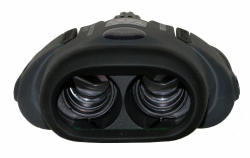 Rollover image with mouse
The focus knob is centrally
located and less than half an inch wide, but it is raised enough above
the prism housing to be easily accessible. It is made of deeply-ridged,
hard plastic and turns with great ease, making for extremely precise focus.
We soon noticed that the Papilios take fully 3.1 turns of the focus knob
to go from minimum close focus to infinity. There is a really good reason
for this. To achieve that incredible 18-inch close focus without field
collapse, Pentax designed an adjustment for parallax that is, as far as
we know, unique. When focusing, the objective lenses move simultaneously
on non-parallel tracks. When you focus on something further away, the
lenses move toward your eyes and separate from each other; as you focus
on closer objects, they move away from your eyes and converge on each
other. That they do so with such ease and smoothness is nothing short
of remarkable. You’ll have to pardon us, but to optics geeks like us,
this is just really cool!
Specifications
With the 6.5x Papilio, the
field of view at 1000 yards is a very respectable 393 feet, while the
8.5x model is a bit more restricted at 315 feet. In fact, compared to
other mini-binoculars, the Papilios have a relatively large field of view.
We measured the interpupilary distance range of the Papilios at 55 - 74
mm. What does that mean to you? The interpupillary distance is how far
apart your pupils are. For a binocular to be comfortable, the ocular lenses
must be positioned directly over your pupils, and the broader a range
offered by a binocular, the greater the probability that you can do this.
Mini-binoculars often lack sufficient range to be comfortable for all
users but the Pentax Papilios are well designed in this regard. The eye
relief claimed by Pentax is a relatively short 15 mm, though this amount
of eye relief is common in reverse porro prism binoculars. Here we found
something interesting: we used the Papilios with the eyecups fully extended
with comfort. We’ve had had trouble with similar designs from other
manufacturers that claimed equivalent or longer eye relief. Whatever the
cause of this discrepancy, the eye relief of the Papilios was quite adequate.
Optical
and Mechanical Performance
The Papilios show only a little
field curvature with a slight tendency for straight lines to bow inward
at the outer edges of the visual field. We did note a bit of blurriness
at the outer field edges. We saw virtually no color aberration even on
brightly-lit, high-contrast objects, which is fairly remarkable. We detected
no color bias under any light conditions. On the Papilios, the diopter
adjusts with a rotating ring on the right ocular tube. The ring turns
with relative ease through a series of closely-spaced click-stops. Thus,
while not a locking mechanism, any selected position is stable. A raised
line on the ring lines up with a raised dot in the rubber armoring of
the ocular tube to indicate the position for equal eyes. The eyecups adjust
with a helical twist mechanism through three positions: fully in, fully
out and halfway between. Each position is stabilized against collapse
by detents. These are fairly elegant refinements on a binocular of this
class.
Design
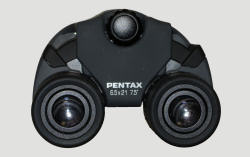 Rollover image with mouse
Pentax used an interesting
structural design feature: instead of a single central hinge, the Papilios
have two “wings” that hold the ocular lenses and attach to the main
chassis by separate hinges. Moving either wing causes the other to move
the same amount. The body is encased in textured dark green rubber armoring
that imparts a secure grip and a nice feel. The ocular wings have shallow
thumb grooves, as does the bridge structure between them. There is a tripod
attachment site on the underside of the body. This feature would be useful
if one were studying a particular object or creature for a long period
of time or trying to sketch from nature.
Accessories
The thin nylon web strap has
plastic attachments that snap into recessed grommets in the surface of
the wings. This attachment allows the entire assembly to rotate around
the attachment point, for greater user comfort. The strap attachments
fit so closely against the body of the binocular that they avoid chafing
against the hands, a frequent problem for other mini-binoculars. The rainguard
is a hard plastic pair of cups held together by a bridging section. The
fit over the soft rubber of the eyecups is tight enough that they do not
dislodge easily so the rainguard won’t get knocked off inadvertently.
There are no lens caps for the recessed objective lenses. Also included
is a padded black case, which is large enough to hold the binocular with
the eyecups extended so they don’t have to be folded down before being
put away. The binocular strap fits out the sides of the Velcro-closing
flap so that binocular and case can be worn over the neck or shoulder.
The case also features a belt-mounting loop on the back for convenient
deployment at the waist. This helps because, without a strap for the case
itself, you would have to hold the case if you carried it into the field.
Our
Conclusions
All the great design and remarkable
engineering of the Papilios comes at a surprisingly low price: the 6.5x
model sells for just
$119.00,
while the 8.5x model is only
$139.00.
Though the Papilios were optimized primarily as butterflying binoculars,
their versatility makes them ideal for a wide variety of other activities.
They are easily tucked into a glove compartment so you can have them everywhere
you go. Their smooth operation and light weight makes them easy for young
children to use. Their ability to function like a hand-lens gives them
an extra dimension in the field. For up-close study of butterflies, birds,
bugs, blooms or whatever, Pentax Papilio binoculars are hard to surpass.
Buy Pentax
Papilio Binoculars