Designation and Consideration
Designation
 All binoculars are labeled
with numbers delineating their size and magnification. These numbers might
look like 8x42 (read as 8 by 42). The 8 in this example is the power or
magnification. The 42 is the diameter (in millimeters) of the objective
lens, the end through which light enters the binoculars (see Figure #1
or Figure #2 in "Basics I - Designs").
These numbers define only magnification and size and not any other aspects
of the image or optics quality.
All binoculars are labeled
with numbers delineating their size and magnification. These numbers might
look like 8x42 (read as 8 by 42). The 8 in this example is the power or
magnification. The 42 is the diameter (in millimeters) of the objective
lens, the end through which light enters the binoculars (see Figure #1
or Figure #2 in "Basics I - Designs").
These numbers define only magnification and size and not any other aspects
of the image or optics quality.
Full-size binoculars generally
range from 7 to 12 power. The objective lenses range from about 30 to
50 millimeters in diameter. Of these sizes the most popular are powers
from 8-10.5 with 40-50 millimeter objective lenses. The objective lens
diameters for scopes are larger and the most popular top out at about
85 millimeters.
Objective Diameter
In the example above, the objective
lens diameter is the 42 in the 8x42 designation. The larger the objective
diameter, the more light there is gathered to transmit to the eye. This
translates to greater potential detail and greater color resolution. Of
course, the quality of the optical system, how much magnification there
is (generally, more magnification = less light transmitted) and how stable
the optic is mounted or held will determine how much can be seen. A poor
50-mm objective lens will not give the detail, brightness and color that
a high-quality 42-mm lens will.
Larger objective diameters
also mean more glass and weight. In the case of a spotting scope where
it is mounted on a stable tripod and weight is not as great of a concern,
the larger objectives are helpful. Legitimately, a 50-mm objective lens
is about as much as anyone would want to carry in a binocular with today's
materials. Because of the weight involved, people will often opt for 42-mm
objectives. Top of the line optics are able to deliver extremely sharp
views with a 42-mm objective. In theory, a 35-mm objective in normal daylight
should be able to deliver all the detail we need at normal birding ranges.
When you look into shadow, are in the woods viewing birds at a distance,
in failing light at dusk and dawn or any other condition where bright
light is compromised, a larger objective helps.
Larger objectives are especially
helpful when either the distance increases or bright sunlight is compromised
by any of the factors mentioned above. Both image detail and colors are
limited when the distance increases with smaller objectives... even in
bright light. The basic physics of light are such that the details and
colors simply blend together with smaller objectives. To get a sharp view
with good color, a larger objective is simply necessary. This effect becomes
more apparent as the distance increases or ambient light decreases. Even
looking into a shadow, a 40-50-mm objective is necessary to deliver enough
light to excite the color receptors in our eyes and to give good detail.
Magnification
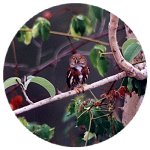
Commonly in the past the most
popular magnifications for field size binoculars were either 8 or 10 power.
This means that the view that is seen is either 8 or 10 times as large
as with the normal eye. Figures #5 and #6 below give an idea of the difference
in view at these two magnifications.
| 8X |
10X |
|

|
| Figure #5 |
Figure #6 |
Several other factors are affected
by magnification, most notably depth of field, field of view, image brightness
and weight, which impacts our ability to hold a binocular steady. These
factors affect how well we can decipher details, how easy the optics are
to use and the fatigue using them causes.
As a matter of simple physics,
image brightness decreases with higher magnifications (assuming the optic
quality and objective diameter remain constant). In other words, as we
zoom in on an image, the brightness drops (try it with a zoom lens on
a scope!). This will determine how well you can distinguish color and
detail.
 Depth of field is how much
depth stays in focus in the field of view. The higher the magnification,
the shallower the region of sharp focus in the image. This affects closer
objects more since the depth of field is greater at larger distances.
For example, imagine focusing on a bird 15 feet away. Maybe everything
in view at 14-17 feet away is still reasonably sharp. If you are looking
at a bird 60 feet away, maybe everything from 55-70 feet away is still
sharp. The bird at greater distance can move around relatively more while
still staying in focus whereas relatively small movements by the nearer
bird require focal adjustments to maintain a sharp view. This may cause
fatigue with extended field time, not only because of adjusting focus
but because our eyes are also doing some of this work (depth of field
is discussed in greater detail in Basics III).
Depth of field is how much
depth stays in focus in the field of view. The higher the magnification,
the shallower the region of sharp focus in the image. This affects closer
objects more since the depth of field is greater at larger distances.
For example, imagine focusing on a bird 15 feet away. Maybe everything
in view at 14-17 feet away is still reasonably sharp. If you are looking
at a bird 60 feet away, maybe everything from 55-70 feet away is still
sharp. The bird at greater distance can move around relatively more while
still staying in focus whereas relatively small movements by the nearer
bird require focal adjustments to maintain a sharp view. This may cause
fatigue with extended field time, not only because of adjusting focus
but because our eyes are also doing some of this work (depth of field
is discussed in greater detail in Basics III).
Field of view decreases as
we, in essence, zoom in on a bird with higher magnification. You can see
this difference in figures #5 and #6 above (field of view is discussed
in greater detail in Basics III). The effects
are that finding a bird and then following it around as it moves can be
more difficult. Younger children or beginners often have trouble finding
birds in smaller fields of view.
A last consideration involves
how steadily you can hold your binocular. Making out details requires
being able to hold the optics steady. When you increase magnification
more movement is apparent in the view. Especially if you are tired after
a long day in the field, holding your binoculars steady can be difficult.
A 12-15x binocular (with the exception of image-stabilized optics) is
just too difficult to hold steady and requires a tripod.
Several of the manufacturers
have now come out with 8.5x and 10.5x binoculars for that extra little
"kick" in magnification. This extra little bit in the case of
the 8.5x might be a comfortable addition for those who are used to 8x
binoculars and the 10.5x just a little bit more for those who are used
to 10x binoculars. With children, due to weight and field of view considerations,
a 7x compact binocular is easier to hold steady and find things.
Weight
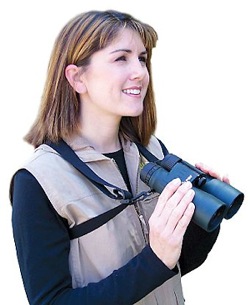 The two most notable concerns
with the weight are related to fatigue and the ability to hold steady.
A well-balanced heavier binocular will also have more inertia, i.e. resistance
to motion. For fatigue related to a having a heavy binocular hanging from
your neck, several kinds of binocular straps and harnesses have been designed
to alleviate this problem. It might seem reasonable that a 28-oz pair
of binoculars is easier to use and hold than a 35-oz pair but sadly it
is not so simple. The ease of use is much more related to how well balanced
the optics are, the distribution of weight into your arms and other factors
that will be discussed further in this and subsequent articles.
The two most notable concerns
with the weight are related to fatigue and the ability to hold steady.
A well-balanced heavier binocular will also have more inertia, i.e. resistance
to motion. For fatigue related to a having a heavy binocular hanging from
your neck, several kinds of binocular straps and harnesses have been designed
to alleviate this problem. It might seem reasonable that a 28-oz pair
of binoculars is easier to use and hold than a 35-oz pair but sadly it
is not so simple. The ease of use is much more related to how well balanced
the optics are, the distribution of weight into your arms and other factors
that will be discussed further in this and subsequent articles.
Most of the popular full-size
binoculars range from about 25-40 oz. Weight may be the single reason
people most often opt for 42-mm objective lens. Optics with 42-mm objectives
generally range from 25-32 oz while 50-mm objectives range from 28-40
oz. Weight is a major consideration when considering how much fatigue
carrying a binocular around in the field all day will cause.
What this doesn't tell us is
how well designed or balanced the optics are. A comfortable placement
of the focusing knob, the fit in your hands and how evenly the weight
is distributed into your arms (balance) may be more important than simply
how much the binoculars weigh. Consequently, a poorly designed and balanced
28-oz binocular can cause more fatigue than a 35-oz pair.
Eye Relief and Eye Cups
Modern binoculars are almost
always designed with eyeglass wearers considered. Eye relief and the design
of the eyecups might be of most importance to eyeglass wearers since their
eyes are physically further away from the eyepiece while wearing glasses,
and being able to adjust the binocular to suit their own glasses is important.
For many visual conditions,
notably near- and far-sightedness, the binocular focal mechanism can compensate
for the problem (astigmatism is not corrected by the optic focus). Most
of the time, we look around with our eyes and then use the binoculars
to look closely at something. If you wear glasses, this means you must
take your glasses off or adjust the eyecups so that you can look through
the binoculars with your glasses on.
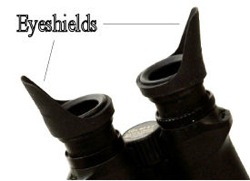 Eye relief is defined as the
distance from your pupil (where the image focuses) to the surface of the
optic eyepiece. To be precise, the image coming out the eyepiece is actually
focused behind the face of the eyepiece. For comfort this distance should
be at least 10 mm. Most wide-angle eyepieces have a shorter eye relief
distance than this. Getting your eye physically closer than 10 mm will
cause undue eye fatigue not to mention physical fatigue fighting off your
automatic blink response.
Eye relief is defined as the
distance from your pupil (where the image focuses) to the surface of the
optic eyepiece. To be precise, the image coming out the eyepiece is actually
focused behind the face of the eyepiece. For comfort this distance should
be at least 10 mm. Most wide-angle eyepieces have a shorter eye relief
distance than this. Getting your eye physically closer than 10 mm will
cause undue eye fatigue not to mention physical fatigue fighting off your
automatic blink response.
Eyeglass wearers need greater
eye relief to compensate for the distance their glasses stand away from
their pupils. This is generally about 12-20 mm where you can see about
80% of the field at the low end and the whole view at the high end. Binocular
eyecups come in multiple designs to provide longer eye relief. Standard
rubber eyecups can be folded back to allow the lens of glasses to sit
physically closer to the eyepiece of the optic. Some of the newer and
high-end optics have adjustable eyecups so the distance can be preset
for comfortable viewing while wearing eyeglasses.
For those with severe eye problems
requiring larger or thicker glasses, “High Eye Point” binoculars are
also available. These are designed with greater eye relief than 20 mm
but they are generally not recommended. The problem with these are that
they can be difficult to keep the circular area that is projected from
the eyepiece both centered and in focus over your pupil. They also tend
to "black out" unpredictably when the eyecup is collapsed. Consequently,
it might be better to use optics with a standard eye relief, and not be
able to quite get close enough to see the whole field.
Exit Pupil
While discussing what comes
out of the eyepiece, we should consider the exit pupil. The exit pupil
is the circular beam of light that comes out of the eyepiece of the optics.
If you hold your binoculars at arms length and look at the eyepiece, you
will see a bright circle of light on the eyepiece. The diameter of that
circle of light is the exit pupil. It is calculated by taking the objective
diameter and dividing it by the power of the optic. For instance, a 10
X 50-mm pair of binoculars has a 50 mm ÷ 10 = 5 mm exit pupil.
The exit pupil has often been
used as a measure of how bright a binocular is, under the premise that
the larger the exit pupil, the more light there is coming out of the eyepiece.
This is absolutely NOT true. Under this premise a 7 X 35-mm optic delivers
as bright an image as a 10 X 50-mm optic, since both 35mm ÷ 7 and 50mm
÷ 10 equal 5mm. Given that the quality of optics is the same, the 10
X 50mm binocular is much brighter.
The exit pupil measurement
does have some use though. In bright light, your eye pupils are normally
open to about 2-3 mm. If the exit pupil of the binoculars is close to
this number your eye must be directly centered over it in order to see
through the optics. This can be important if you are on a bouncing boat
where keeping your eye centered exactly over the exit pupil might be difficult.
Some articles claim that optics
with larger exit pupils than your eye pupils are a waste of light. If
the exit pupil was used as a measure of brightness this may be true, but
only because brightness does not increase when the exit pupil exceeds
the diameter of your eye pupil. This is a key issue with compact binoculars.
A pair of 10x28 or 8x21 compacts have an exit pupil that is less than
3 mm which can be especially difficult to center exactly over the pupils,
and thus difficult to see properly with. This is further complicated in
dim light when your eyes dilate. By about the age of 40, our eyes reach
a maximum dilation of about 5 mm, so if you're using binoculars in all
light conditions you would want at least a 5 mm exit pupil.
Exit pupil may indicate the
ease of use but has no real value in reference to brightness. This measurement
fails to take into account optical glass quality and alignment of optical
elements. These factors have a greater impact on how bright an image is
delivered to your eyes.
Twilight Factor
While on the topic, we should
also mention the myth of twilight factor. This is another measurement
based on the physical size of the optic and does not take optic quality
into consideration. The twilight factor is derived by multiplying the
objective diameter by the magnification and then taking the square root
of this product. Thus a 10x40mm binocular has a product of 400 as you
multiply the objective diameter by the magnification (10 X 40 = 400).
The square root of this is 20 (√400=20).
This number may seem reasonable
when comparing a 10x42 pair of binoculars that has a twilight factor of
20.5 with an 8x35 pair that has a twilight factor of 16.7. In reality,
it has little validity since it is actually objective diameter that might
make the 10x42 brighter than the 8x35 optic. This is immediately apparent
if you compare an 8x42 with a twilight factor of 18.3 and the 10x42 with
a twilight factor of 20.5. As noted before, brightness declines as magnification
increases. Again, this does not take optic quality into consideration
that has tremendous impact on the perceived brightness of the optics.
Conclusions
- The optic designation only defines size and magnification
- not optical quality.
- Greater objective diameters are required for optimal
viewing in all conditions.
- There are "trade offs" that come with higher
magnifications.
- Weight is an important issue but ergonomics may be more
critical.
- Eye relief is important to all users. The eyecups adjust
to allow eye glass wearers the ability to look through their binoculars
without always having to first remove their glasses.
- Neither exit pupil nor twilight factor tells you anything
about actual performance or optic brightness.
Previous Article - Basics
I | Next Article - Basics III